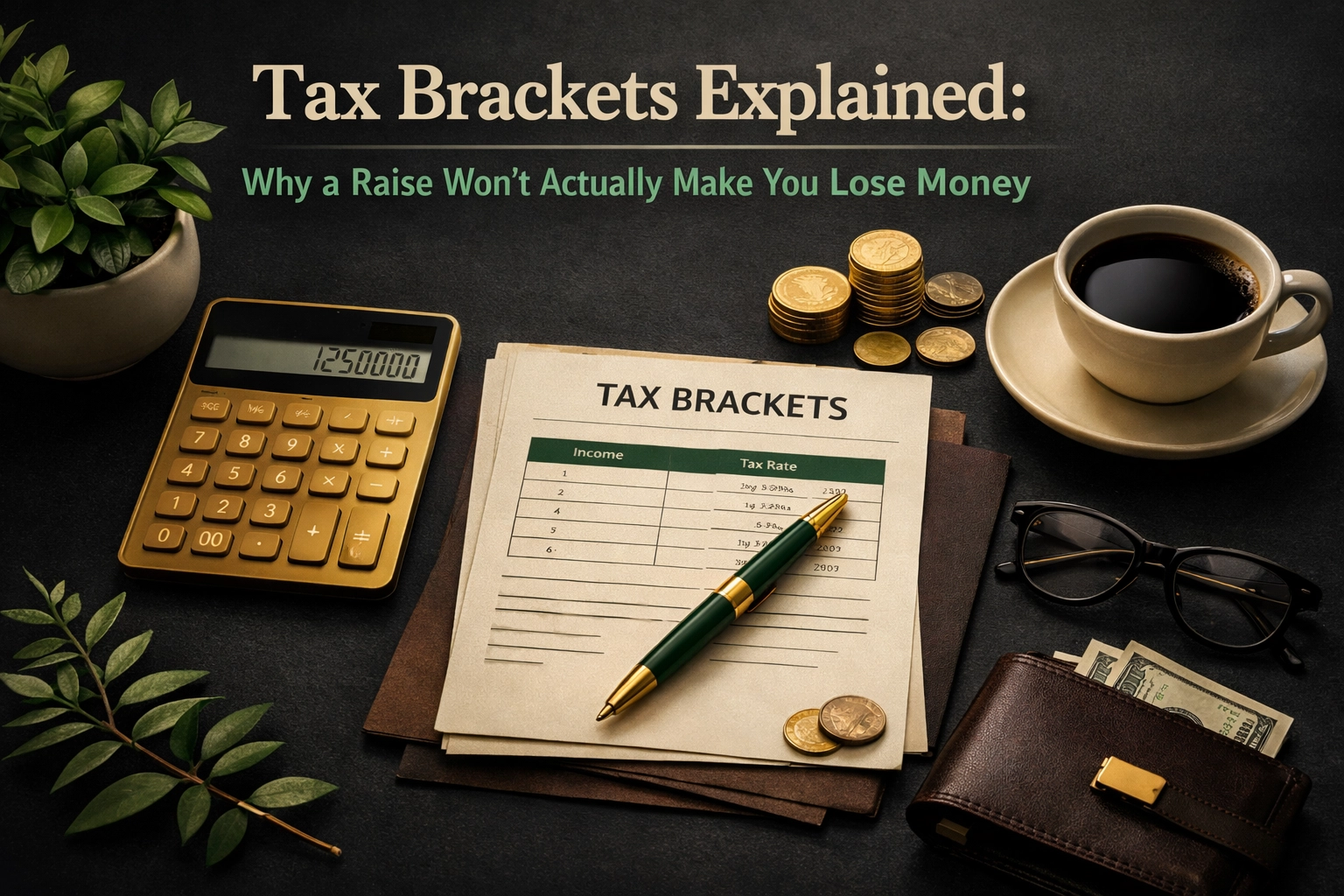
Tax Brackets Explained: Why a Raise Won't Actually Make You Lose Money
Ever heard someone say, "I don't want that raise, it'll bump me into a higher tax bracket and I'll actually lose money"?
Yeah, that's not how it works. Like, at all.
This myth has been floating around forever, and it's caused a lot of people to turn down opportunities, avoid side hustles, or stress out unnecessarily come tax season. So let's clear this up once and for all, in plain English, no fancy tax jargon required.
What Are Tax Brackets, Really?
Think of tax brackets like buckets. The IRS divides your income into different buckets, and each bucket gets taxed at a different rate. The more you earn, the more buckets you fill up.
Here's the key thing: only the money in each bucket gets taxed at that bucket's rate. Your entire income doesn't suddenly get taxed at a higher rate just because you earned a bit more.
The U.S. has seven federal tax brackets with rates of 10%, 12%, 22%, 24%, 32%, 35%, and 37%. For 2026, if you're a single filer, here's roughly how it breaks down:
- 10% on the first $12,400
- 12% on income from $12,401 to $50,400
- 22% on income from $50,401 to $105,700
- And it continues up from there
The system is what we call "progressive." That just means the more you make, the higher percentage you pay, but only on the income that falls into those higher ranges.

Who Does This Apply To?
Short answer: everyone who pays federal income tax.
Whether you're a realtor closing deals, a DoorDash driver hustling on weekends, a photographer booking sessions, or a gym owner running your own LLC, this applies to you. It doesn't matter if you're W-2 or self-employed. Tax brackets work the same way for all of us.
If you have taxable income, you're dealing with brackets. And understanding how they actually work can save you a lot of unnecessary worry.
Let's Walk Through a Real Example
Okay, this is where it clicks for most people. Let's use some actual numbers.
Say you're a single filer making $50,400 in 2026. Here's how your taxes break down:
- The first $12,400 is taxed at 10% = $1,240
- The next $38,000 (from $12,401 to $50,400) is taxed at 12% = $4,560
Total federal tax: $5,800
Now let's say you land a new client, pick up extra gigs, or get a nice raise. Your income jumps to $60,400.
Here's what happens:
- The first $12,400 is still taxed at 10% = $1,240
- The next $38,000 is still taxed at 12% = $4,560
- The additional $10,000 (from $50,401 to $60,400) is taxed at 22% = $2,200
New total federal tax: $8,000
So yeah, you're paying $2,200 more in taxes. But you also made $10,000 more. That means you're still taking home an extra $7,800 after taxes.
More money is more money. Period.

The Biggest Mistake People Make
Here's where the myth comes from: people assume that moving into a higher bracket means ALL their income gets taxed at that higher rate.
Nope.
Only the income within that bracket gets the higher rate. Your previous income stays exactly where it was, taxed at the lower rates. The system is designed so that earning more never actually costs you money.
Let's say it louder for the people in the back: A raise will never make you lose money because of taxes.
You might owe more, sure. But your take-home pay will always go up when your gross income goes up. That's just math.
This misunderstanding has led people to:
- Turn down promotions or raises
- Avoid taking on extra clients
- Skip side hustles that could've boosted their income
- Feel stressed about their business growing
Don't let a myth hold you back.
Why Understanding This Actually Matters
When you understand how tax brackets work, you can make smarter decisions about your money:
1. You can plan better. Knowing roughly how much of your next dollar will go to taxes helps you budget, price your services, and set financial goals.
2. You stop fearing success. Seriously. Once you realize earning more doesn't hurt you, you can pursue those opportunities without hesitation.
3. You understand your effective tax rate. Your "effective" rate is what you actually pay overall: not the highest bracket you hit. In our example above, someone making $60,400 paid $8,000 in taxes. That's an effective rate of about 13.2%, not 22%.
4. You can have better conversations with your tax professional. When you understand the basics, you can ask better questions and make informed decisions together.

A Few More Things to Keep in Mind
Tax brackets are just one piece of the puzzle. Your actual tax bill depends on a bunch of other factors too:
- Deductions (standard or itemized) reduce your taxable income
- Credits reduce your actual tax bill dollar-for-dollar
- Self-employment taxes are separate from income tax
- State taxes vary widely: some states have their own brackets, some have flat rates, and a few have no income tax at all
So while understanding brackets is super helpful, it's not the whole picture. That's why working with someone who knows your specific situation can make a real difference.
Quick Recap
- Tax brackets are like buckets: each one has a different rate
- Only the income in each bracket gets taxed at that rate
- Moving into a higher bracket doesn't mean all your money is taxed higher
- A raise always results in more take-home pay
- Your effective tax rate is usually way lower than your top bracket
Still Have Questions?
Look, taxes can feel overwhelming: especially when you're running your own business, juggling gigs, or just trying to figure out how all this stuff applies to your situation.
If you're unsure how tax brackets affect your specific income, or you want to make sure you're not leaving money on the table, let's chat. No judgment, no pressure: just straight answers.
Schedule a consultation here and let's make sure you're set up for success.
You've got this. And we've got you.
For more helpful tax tips and resources, visit Small Business Tax Solutions or check out our FAQ page.