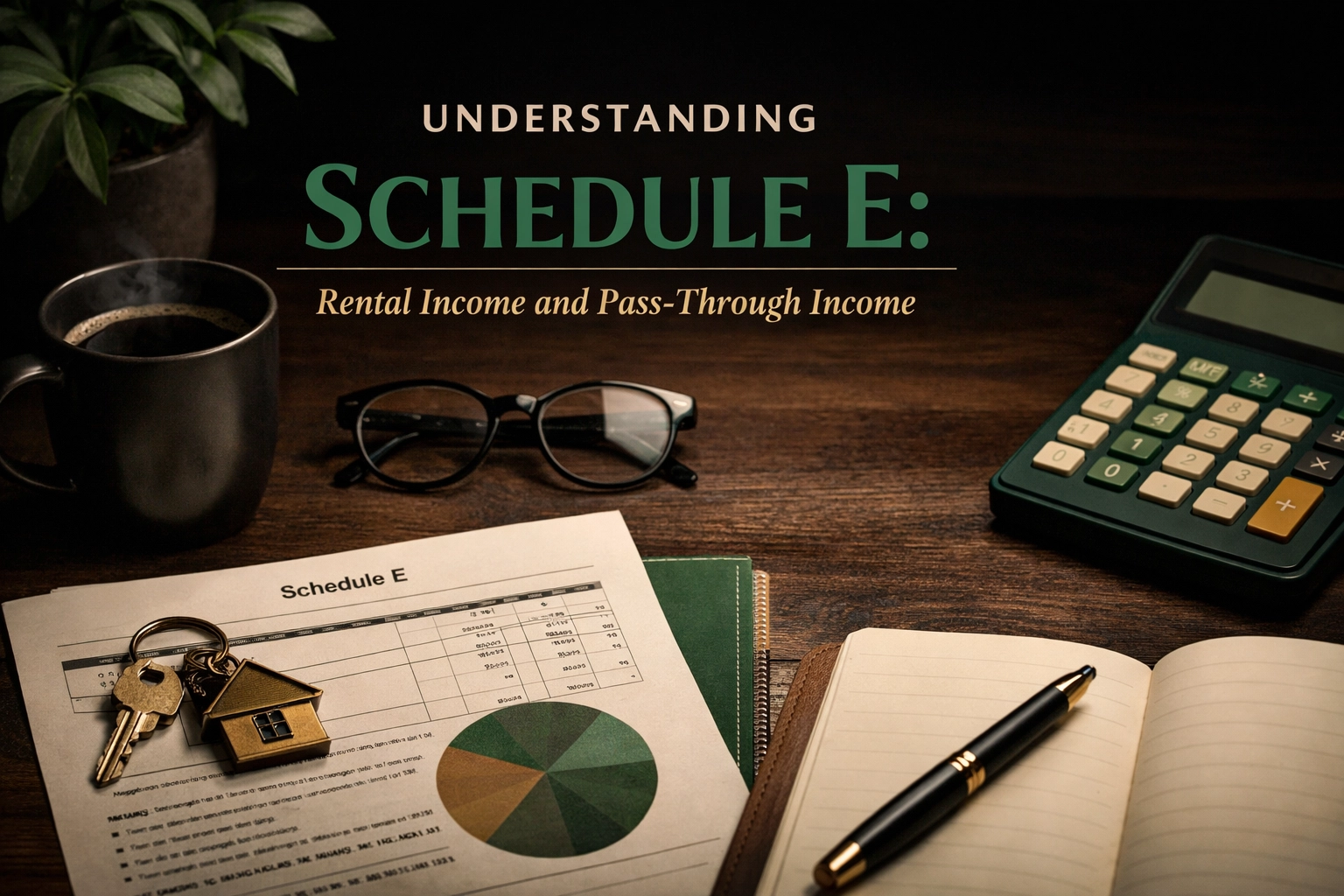
Understanding Schedule E: Rental Income and Pass-Through Income
If you own rental property or have ownership in a partnership or S-corporation, you’ve probably seen the words “Schedule E” floating around. Maybe your tax preparer mentioned it. Maybe you spotted it in your tax software and thought, “What is this, and why do I need it?”
You’re not alone. Schedule E confuses a lot of people because it covers multiple types of income that don’t fit neatly into a paycheck or a typical business. But here’s the good news: once you understand what Schedule E actually does, it starts to make a lot more sense.
Let’s break it down in plain English.
What Is Schedule E?
Schedule E is an IRS tax form that attaches to your personal tax return (Form 1040). Its official name is “Supplemental Income and Loss,” which is the IRS’s way of saying “income that doesn’t come from a regular job or a business you run day-to-day.”
Think of Schedule E as the home for two main types of income:
1. Rental Real Estate Income
If you own property and rent it out, whether it’s a house, an apartment, a commercial building, or even a vacation rental, the money you collect (and the expenses you pay) gets reported on Schedule E.
2. Pass-Through Income
If you’re a partner in a partnership or a shareholder in an S-corporation, the business itself doesn’t pay income tax. Instead, your share of the profits (or losses) “passes through” to your personal tax return. That pass-through income lands on Schedule E.
The form has different sections for different income types, but you only fill out the parts that apply to you.

Who Needs to File Schedule E?
Schedule E applies to more people than you might think. You likely need it if you have:
- Rental property income – You own a home, duplex, condo, or commercial space that you rent to tenants
- Vacation rental income – You list a property on Airbnb, VRBO, or similar platforms
- Partnership income – You’re a partner in a business structured as a partnership (you’ll receive a Schedule K-1)
- S-corporation income – You’re a shareholder in an S-corp (you’ll also receive a Schedule K-1)
- Royalty income – You receive royalties from oil, gas, mineral rights, or intellectual property
- Trust or estate income – You received distributions from a trust or estate
Here’s an important exception: If you provide substantial services to your tenants, like daily cleaning, meals, or concierge-type services, your rental activity might actually be considered a business. In that case, you’d file Schedule C instead of Schedule E. The distinction matters because Schedule C income triggers self-employment tax, while Schedule E income typically does not.
Not sure which applies to you? That’s a great question to ask a tax professional.
A Simple Example
Let’s say you own a small rental house. Here’s how Schedule E works in practice:
Maria’s Rental Property
Maria bought a rental house three years ago. In 2025, she collected $18,000 in rent from her tenants. Throughout the year, she paid:
- $4,000 in mortgage interest
- $2,500 in property taxes
- $1,200 in insurance
- $800 in repairs (new water heater, fixing a fence)
- $3,500 in depreciation (the IRS lets you deduct a portion of the building’s value each year)
Maria’s Schedule E would show:
- Rental income: $18,000
- Total expenses: $12,000
- Net rental income: $6,000
That $6,000 flows to Maria’s Form 1040 and gets added to her other income for the year. She pays regular income tax on it, but she doesn’t owe self-employment tax on rental income.

Now let’s look at pass-through income:
James’s S-Corporation
James owns 25% of an S-corporation with three other partners. The business made $100,000 in profit for the year. James receives a Schedule K-1 showing his share: $25,000.
James reports that $25,000 on Part II of his Schedule E. He pays income tax on it, even if the money stayed in the business and he never actually received a check.
That’s the key thing about pass-through income: you’re taxed on your share whether you take the cash or not.
Common Mistakes People Make with Schedule E
Even experienced taxpayers trip up on Schedule E. Here are the mistakes we see most often:
1. Forgetting to Report All Rental Income
Every dollar of rent you collect is taxable: including security deposits you keep, late fees, and any services tenants provide in exchange for reduced rent. If a tenant paints your property instead of paying $500 in rent, that’s still $500 of income.
2. Missing Deductible Expenses
On the flip side, many landlords forget to deduct legitimate expenses. Things like advertising costs, travel to check on the property, professional fees, and even a portion of your home office (if you manage rentals from home) may be deductible.
3. Not Understanding Depreciation
Depreciation is one of the biggest tax benefits of owning rental property, but it’s also one of the most misunderstood. The IRS lets you deduct a portion of your building’s value each year (not the land: just the structure). This is a real deduction that reduces your taxable income, even though you didn’t spend any cash.
Many DIY filers skip depreciation because they don’t understand it. That’s money left on the table.
4. Mixing Up Personal and Rental Use
If you use your rental property for personal purposes: even for a few days: the rules get complicated. The IRS has specific formulas for splitting expenses between personal and rental use. Vacation rentals especially need careful tracking.

5. Filing Late Because of K-1 Delays
If you have pass-through income, you need a Schedule K-1 from the partnership or S-corp before you can file your taxes. These forms are due to you by March 15, but businesses often run late. If you’re waiting on a K-1, you might need to file an extension for your personal return.
6. Confusing Schedule E with Schedule C
This one’s important: Schedule E is for passive rental income. Schedule C is for active business income. If you’re running a rental like a hotel (providing substantial services), you may need Schedule C instead. Using the wrong form can mean paying the wrong amount of tax.
Why Schedule E Matters at Tax Time
Schedule E isn’t just paperwork: it directly affects how much tax you owe.
For rental property owners:
- Your rental income increases your taxable income
- Your deductible expenses (including depreciation) reduce your taxable income
- Rental losses may offset other income, but there are limits based on your participation and income level
For pass-through income:
- Your share of partnership or S-corp income is taxed on your personal return
- You may qualify for the Qualified Business Income (QBI) deduction, which can reduce your tax by up to 20% on that income
- Losses may be limited by basis rules, at-risk rules, and passive activity rules
Getting Schedule E right means you’re not overpaying: and you’re not underpaying and risking IRS problems later.
The Bottom Line
Schedule E handles income that doesn’t fit the standard mold: rental properties, partnerships, S-corporations, royalties, and more. If you have any of these income sources, this form is part of your tax life.
The good news? You don’t have to figure it out alone. A tax professional can make sure you’re claiming all your deductions, using depreciation correctly, and reporting everything the IRS expects to see.
If you’re unsure how Schedule E applies to you, schedule a consultation. We’ll walk through your specific situation and make sure your rental or pass-through income is handled the right way.